Search Engine Optimization – 2026

Guide: SEO for Beginners — 10 Steps to the Top of Search Engines
Table of contents: Introduction
SEO for Beginners
SEO, or Search Engine Optimization, is essential if you want to run a business online
This quick SEO guide covers every small and large optimization you need to get your site appearing in Google’s top results.
The list is written from more than 10 years of SEO experience (see who I am).
It works for both small and large websites — for online stores and regular sites alike.

How do I use this quick SEO guide?
These are the steps that have delivered huge results for hundreds of websites I’ve worked on.
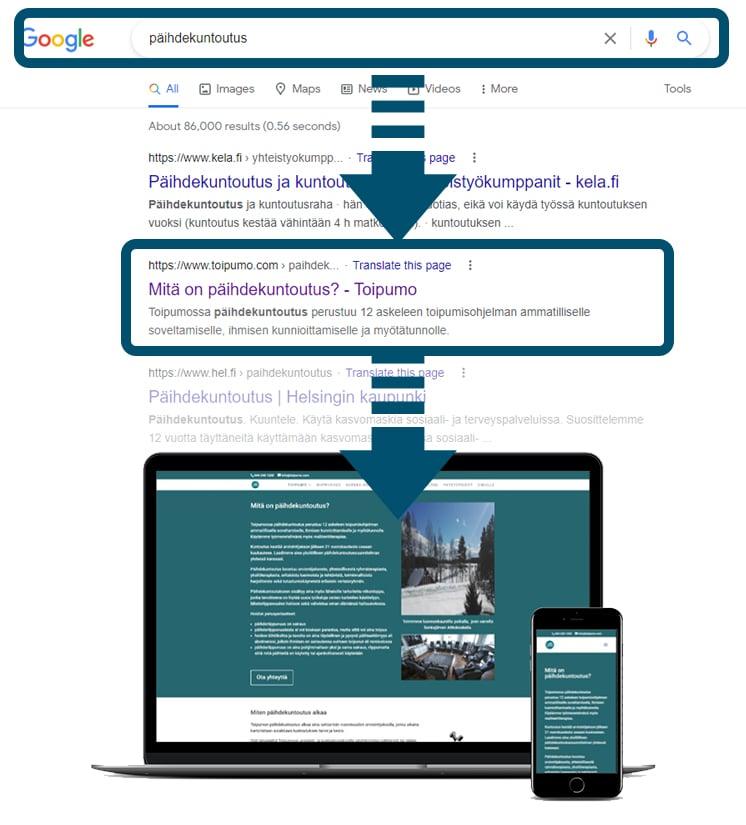
Toipumo earned a top-3 ranking for the highly competitive term "päihdekuntoutus" thanks to these guidelines.
Many people don’t know this, but addiction treatment centers can’t advertise on Google because the topic is too sensitive.
For that reason, all addiction rehab facilities have to rely solely on organic search results. You can’t buy visibility.
You don’t have to follow this guide word for word, though.
SEO is a multifaceted process, and often making a few strategic changes is enough to significantly improve your visibility.
SEO basics
Set up Google Search Console
Google Search Console is the best tool for tracking SEO. It’s data straight from Google.
With Google Search Console you can track exactly which keywords your site appears for in Google and which search terms people actually clicked.
- See which words bring the most visitors to your site
- Identify your site’s most important pages from an SEO perspective
- See which sites link to yours
- Submit your sitemap to Google
- Check your site’s loading speed
- Check your site for errors
- Check your site’s security
I’d argue that Google Search Console is the single most important SEO tool.

Install Bing Webmaster Tools
Did you know OpenAI’s ChatGPT uses Bing as its search engine? Being visible in Bing matters now more than ever.
With Bing Webmaster Tools you can help Bing find your site and include it in search results.
That way you’ll automatically gain visibility in ChatGPT as well.

Install Google Analytics
The world’s most popular analytics tool—for free
With Google Analytics you can
- Track how many visitors you get from Google
- See what visitors do on your site
- Find out whether visitors complete the actions you want (for example, contact you)
- See which sources send traffic to your site
Pro tip: Connect Google Analytics and Search Console so they can share data

Install Yoast SEO (WordPress and Shopify)
Yoast SEO is the world’s most popular SEO tool. Available for WordPress and Shopify.
Yoast SEO helps you optimize your site for search engines using an easy traffic-light system.
Most of the time, when you get all the lights green, your visibility on Google is excellent.
There’s a paid version of Yoast, but I’ve personally always managed with the free version. Decide for yourself whether you want to pay for extra features.

Decide what you want to achieve and set KPIs
(Key Points of Interest)
Are you aiming for more sales with SEO? More visits? Or something else?
Here are common goals:
- Organic traffic. More visitors to your site is always a good thing.
- Brand awareness. Better visibility across search results raises awareness of your brand. It also works the other way around: well-known brands often rank well in Google because their results get clicked more.
- Growing external links (backlinks): External links, or backlinks, are still one of the biggest factors in search visibility. Links from trusted sites signal that your content is valuable enough for others to cite as a source.
- A specific ranking in search results. Sometimes the goal of SEO is simply to improve visibility for a particular search term. Maybe you want to move a major keyword from #10 to #3.
By defining one or more goals, you can track SEO results more precisely.
I recommend building a dashboard in Google Looker Studio (formerly Data Studio) so you can easily monitor these metrics as your SEO progresses.

(optional) Set up Wincher
Wincher is my favorite tool for tracking SEO (a SERP tool).
With Wincher you can
- Immediately test what position you appear in for specific search terms
- Compare how you rank against others appearing for the same search
- Compare the quality of your site to competing sites
- Easy email reporting
- Simple dashboard

Keyword research
Keyword research is the cornerstone of search engine optimization. Without keyword research, you’ll be doing SEO blindfolded.
Know your audience
Identifying your audience is crucial for SEO. You need to understand what people mean when they search for something (search intent)
Consider:
- Who is your ideal customer? What does their customer profile look like? What language do they use and what kind of content do they consume?
- What problem do they have? How can you help them solve it.
- What are they looking for? Are they searching for a service or just general information about one? Are they ready to buy or only comparing options?
Try Google autocomplete
Give Google one word and see what other words it suggests
Each of these words are things people search a lot on Google.
They also work as suggestions for topics you should write about on your sites.
This data comes straight from Google, so I believe these words are very important. Google’s automatic search suggestions are the easiest way to do keyword research.

Sign in to the Google Keyword Tool
In my opinion, Google’s own keyword tool is the best
With Google’s keyword tool you can
- Find out how often specific search terms are queried in different countries and languages
- Get ideas for other related keywords
- See the search history for keywords
- See how much advertisers are willing to pay to appear for those terms (competition)
- Export keywords to Google Sheets

Export your keyword list to Google Sheets
Export keywords from Google’s Keyword Planner to Google Sheets and color-code them
Turn your keyword list into a filter and add conditional formatting so you can color-code keywords like in the example.
This makes it easy to spot the best keywords to focus on for SEO.

On-site SEO
Now’s the time to optimize your site’s content and create new material.
Add the keyword to the page URL
Keep your site’s URLs clear and easy to read.
Be sure to include the keyword you want the page to rank for in the URL.
For example: this page’s URL is /hakukoneoptimointi-pikaopas because I want it to appear for the search "Hakukoneoptimointi pikaopas."

Use the shortest URLs possible
Keep your URLs concise.
Why?
Backlinko analyzed 11.8 million Google searches and found that shorter URLs tend to perform best. See the study here.
Put the search term at the start of the main page heading
The search term you want your site to show up for should appear at the start of the page’s main heading
Add a variable to the main headline
Research shows adding variables to headlines increases click-through rates
Examples of variables include:
- Best
- Checklist
- Guide
- [current year]
- Review
- Call to action
Use the keyword in the page’s first paragraph
Remember to include your chosen keyword in the text of the first paragraph as well
This helps Google more reliably rank the page for the exact search term you want it to appear for

Use the search term in the page’s H1, H2, H3 headings
Make sure the search term appears in the page headings

Optimize images
Remember to add ALT texts to images on the page
Add ALT text to your images. It helps Google match images to the right searches in Google Images.
It also helps visually impaired users who rely on screen readers on your site.
Use synonyms
For example, if you want to appear for the search "How to start a blog"
You should also use these phrases in the page copy
- How to set up a blog
- Starting a blog
- How to start a WordPress blog
- Here’s how to start a blog
LSI keywords (Latent Semantic Indexing) are terms closely related to your main keyword. In other words, words you’d expect to see when talking about your target topic.
For example:
- Writing
- Website
- Content creation
These words probably won’t boost your ranking on their own, but they help Google better understand what your content is about.
Use external links
That is, link to sites outside your own
Linking to other high-quality sites boosts the credibility of your own content.
- Link to sources
- Link to explanations when you use technical terms
Use internal links
Give readers a path to keep reading
As a rule of thumb, all content on your website should be no more than 2–3 clicks away. From every page, visitors should be able to continue to other related content.
Pro tip: On a WordPress site you can use the Internal Link Juicer plugin to automatically link specific words to specific pages.

SEO for written content
You can’t show up in Google without brilliant content.
Make your text readable
No one likes walls of text
That’s why it’s a good idea to break up walls of text into paragraphs no longer than about three lines.
This keeps your page’s bounce rate lower and helps people find the exact piece of information they’re after amid everything else.
See what others do — then do it better
Google the search term you want to rank for, visit the top 3 results, and think about how you can write content that’s even better than theirs
Think about what added value your content provides
A shallow, surface-level take on a topic no longer guarantees a lasting spot in Google. You can’t just stitch together the subheadings (H2s) from current top results and call it finished content.
You need to deliver added value — more than what the existing search results already offer.
Why would Google surface your content? And why would readers choose yours over the rest?
Use multimedia
Images, videos, lists, tables, infographics
There are two reasons for this:
First: visualizing content makes it higher quality.
Second: multimedia pages tend to rank better in search results, according to studies.
I recommend adding high-quality multimedia to every page on your site
- Images
- Charts
- Infographics
- Visual content
- Videos
- Surveys
- Tables
Technical SEO
Technical SEO ensures your site can be read
Find your site’s error messages and loading speed
See whether Google found errors on your site
If your site has technical issues with security, mobile optimization, loading speed, or other content, it won’t appear in Google.
You can easily view error messages in Google Search Console

Make sure Google can see your pages
Sometimes people can see your site, but Google can’t
If Google can’t read your pages, you won’t appear in Google.
Try the Search Console "Inspect URL" tool
Make sure that
- Google has indexed the page
- The Crawled As field shows "Googlebot"
- There are no errors on the page
If the tool says the page is NOT indexed, you can request that Google index it.

Ensure mobile friendliness
70% of your visitors use a mobile device
If your website isn’t mobile-friendly, you won’t show up in Google.
- Use responsive design. Make sure every element on your site adapts to the user’s screen size.
- Keep paragraphs short. Make sure paragraphs are
- Avoid pop-ups
Fix broken links
Broken links hurt search visibility and user experience
The easiest way to check the links on your site is DrLinkCheck.com.
A free tool for scanning links.

Protect your site with HTTPS
HTTPS has long been a confirmed Google ranking signal.
So if you haven’t already, it’s time to move your site to HTTPS.

(Or if you just launched a new site, set it up with HTTPS on day 1.)
That’s it for this check. It’s that simple.
Use Schema markup
Structured data, or Schema, helps search engines understand your content better. It can also help you get rich results, such as star ratings and a recipe’s cooking time, shown in the search results.
SEO link building
Link building is the key to reaching the top 10 in search engines
How does Google decide which sites make the top 10 for search terms where millions of pages compete?
The answer is links.
Links tell Google a site is trustworthy. But not just any links will do. They need to come from reputable sites in the same industry and in the same language.
Below are instructions on how to build high-quality links.
Write guest posts
Look for blogs in your field where you could contribute a guest post.
Add an author signature at the end of the post and include a link back to your site.
Make your content easy to link to
Make your site a source
Create content people will cite as a source. Do research, run tests, and publish genuinely interesting material.
Steal your competitors’ links
See which sites link to the top 3 competitors’ pages.
Consider whether you can get those same links.
Appear on podcasts
Be a guest on podcasts in your field and ask them to add a link to your site on the episode page.
Give references
Provide testimonials, reviews, and references for others. Ask that your site be linked alongside the review.
Pro SEO Tips from the Pros
Republish Old Blog Posts
Do you have blog posts from years ago?
Are they buried at the back of your blog archive?
Republish your old posts. It’s an easy way to help older content perform better in Google.
Remove "Zombie Pages"
Check whether your site has a lot of pages that nobody visits.
These can include things like blog category pages or keyword tag pages.
Removing these “zombie” pages can improve your visibility in Google search results.
Final words from the SEO quick guide
Congratulations. You’ve just finished the SEO quick guide.
If you want to dive deeper into SEO, read the search engine optimization guide for professionals that I wrote
Need help?
Book a free SEO check: in a 60-minute video call we look at how your website shows up on Google in Finland and what to fix first.
Free SEO check
A 60-minute Google Meet call: we look at how your website shows up on Google in Finland.